
Dear CEO, Founder, Executive under pressure
Just enough to keep the job.
Just enough to avoid the difficult conversation.
Just enough to look busy, sound fine, meet the minimum, and quietly disappear inside the payroll.
They attend the meeting.
They answer the email.
They complete the task.
They arrive on time, remain visible, say the appropriate things, and keep the organisational machinery turning.
Yet something essential is missing.
Their body is in the room.
Their full contribution is elsewhere.
And how would you know?
In the absence of a digital bio-dipstick…
You do not have a digital dipstick you can place into someone’s body to measure whether they are bringing their full head, heart, hands, talent, energy, focus, creativity, care, and courage to work.
You cannot insert a diagnostic instrument and receive a neat reading:
Presence: 100%.
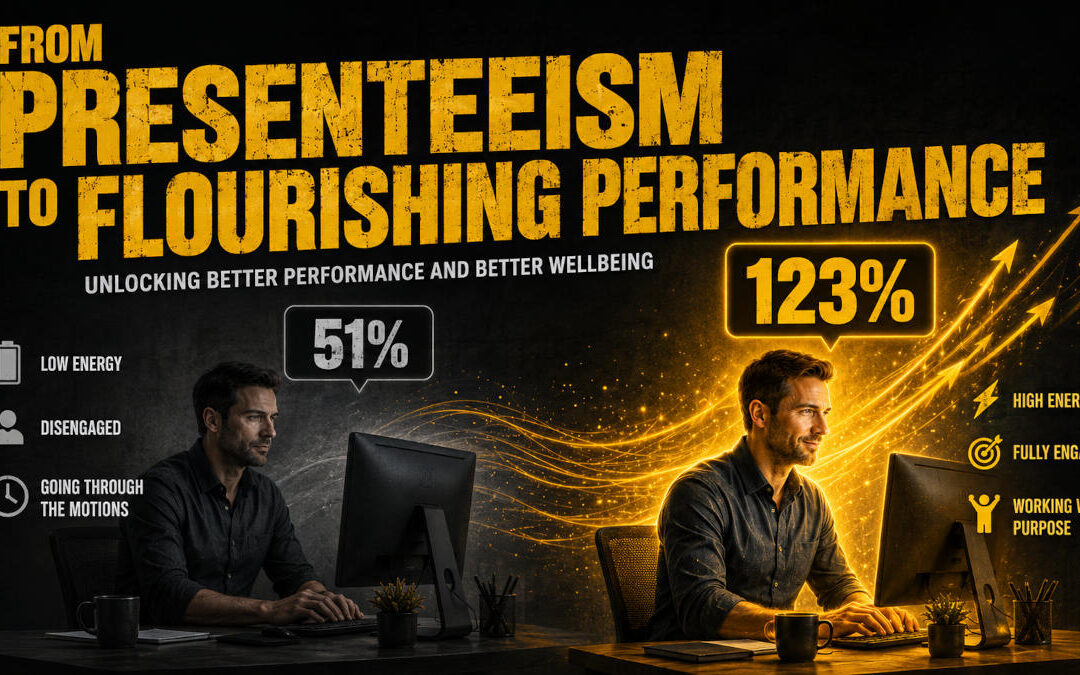
Contribution: 51%.
Human energy available: declining.
That is the silent trouble with presenteeism.
People are physically present.
Calendar says yes. Computer says yes. Chair says yes.
But their eyes?
Perhaps 51% yes. Perhaps 49% no.
An almost invisible internal friction.
A person divided between the work in front of them and the life happening inside them.
The whole human is quietly negotiating exhaustion, pressure, conflict, debt, relational strain, low meaning, low trust, limited growth, and the slow erosion of:
“Why am I even doing this?”
Download Your Presenteeism Self-Assessment Questionnaire
Download for your and your team’s self-assessment value. Constructive coffee afterwards may aid the acceleration of individual and team flourishing.
The Invisible Pie Chart
Presenteeism is rarely caused by one dramatic event.
It is usually an invisible pie chart of accumulating pressure.
A slice of financial stress.
A slice of personal and family pressure.
A slice of workplace friction.
A slice of unclear purpose.
A slice of low mastery, where people repeat familiar tasks without experiencing growth.
A slice of low contribution, where people feel useful to the system and unseen as human beings.
A slice of prolonged performance pressure without meaningful wellbeing development support.
A slice of leadership that relentlessly chases numbers while wellbeing sits on a decorative little island somewhere far away from the engine room.
Too many meetings per week?
A slice of professional conflict people carry in their heads and hearts long after the meeting has ended.
A slice of private pain people cannot simply leave at the door.
Because human beings are gloriously, inconveniently whole.
We bring our full lives to work, even when we say very little about them.
A strained relationship travels with us.
A sick parent travels with us.
A child in difficulty travels with us.
Debt travels with us.
Fear travels with us.
An unresolved disagreement from yesterday’s executive meeting travels with us.
So does the quiet suspicion that our work no longer matters.
These pressures do not always produce obvious absenteeism.
Sometimes they produce a subtler withdrawal.
The person arrives.
The person performs.
The person contributes enough to remain undetected.
And slowly,
100% human capacity becomes 70%.
Then 61%.
Then 51%.
The Better Leadership Question
We keep asking: “How do we improve performance?”
Good question.
Here is a better one:
“How do we help people WANT to bring more of themselves to the work?”
How do we create an environment where people voluntarily bring their leadership, thinking, imagination, judgment, initiative, energy, and care?
How do we help someone reconnect with meaning, mastery, contribution, responsibility, and hope?
Because the unlock is seldom another dashboard.
Another metric.
Another red, amber, and green report.
Another performance-management template.
Measurement has value.
Clarity has value.
Accountability has value.
And the human being behind the measurement remains the primary source of sustainable performance.
The journey begins with self-leadership.
Self-leadership grows in cultures where people are invited to become more aware, more honest, more responsible, and more wholehearted.
This is where performance becomes personal.
Not personal in a boundaryless or intrusive sense.
Personal in the most professional sense.
The person understands their role.
The person understands their impact.
The person understands what strengthens or drains their contribution.
The person begins taking responsibility for the energy, choices, habits, relationships, and commitments they bring into the workplace.
And leadership creates the conditions in which that responsibility can grow to intrapreneurial contribution.
Start With Your Immediate Team
So, CEO, Founder, Executive under pressure, here’s an immediate step 1.
Cultivate one-to-one relationships proactively.
Do this before the crisis.
Before the resignation.
Before the conflict becomes a grievance.
Before the talented person disappears emotionally and begins quietly searching elsewhere.
Invite your leaders to cultivate the same quality of relationship with their teams.
Create a rhythm of fully human check-ins.
Coffee.
Tea.
A simple, real conversation.
Ask:
“How is the human doing?”
“How is your head?”
“How is your heart?”
“How are your hands?”
“What is taking energy?”
“What is giving energy?”
“Where are you growing?”
“Where are you feeling stuck?”
“What would help you contribute more fully?”
“How can I support you?”
Then listen.
Listen for the answer beneath the efficient answer.
Listen for uncertainty.
Listen for energy.
Listen for frustration.
Listen for aspiration.
Listen for the places where role clarity, relationships, systems, resources, or leadership may be obstructing someone’s best contribution.
This is a human conversation.
Professional boundaries stay intact.
Role clarity stays intact. In fact, it improves.
Performance still matters.
Results still matter.
Accountability still matters.
Commercial reality still matters.
And the full humanity of the person in the role matters too.
These belong in the same conversation.
Better Performance and Better Wellbeing
This is where better performance and better wellbeing stop fighting, and enters a healthy rivalry.
This is where they become dance partners.
People with greater clarity make better decisions.
People with healthier working relationships collaborate more effectively.
People who experience meaning contribute with greater initiative.
People who are growing bring more energy and ideas to complex work.
People who feel trusted are more willing to speak, challenge, create, and take responsibility.
People who are treated as fully rounded human beings are more likely to bring their full human capacity into the room.
Head. Heart. Hands. Thinking. Feeling. Doing.
This is where presenteeism begins to loosen its grip.
This is where people start bringing themselves back into the room.
This is where 51% begins moving toward 75%, 90%, 100%, and sometimes, in those extraordinary seasons of purpose, momentum, and collective endeavour, 123%.
Sustainable synergy?
This is also where you accelerate the preparation of future-ready people.
Fully rounded humans leading humans.
People supported by technology.
People strengthened by meaningful systems.
People capable of adapting, learning, contributing, and flourishing.
The future of work requires excellent technology.
It also requires something technology cannot manufacture on our behalf:
Human awareness. Human courage. Human trust. Human responsibility. Human connection.
The Conversation Before the Intervention
You do not need a grand wellbeing programme to begin.
Isolated wellbeing programmes are often ineffective.
You need a conversation.
Then another.
Then a rhythm.
Then a culture.
A cup of coffee may look insignificant beside a strategic plan, financial forecast, or digital transformation project.
Yet the conversation around that cup may reveal the friction quietly costing the organisation energy, productivity, trust, innovation, and talent.
It may help a person reconnect with their work.
It may help a leader see what the dashboard cannot show.
It may turn silent withdrawal into renewed contribution.
It may help a team member bring their full head, heart, and hands back into the room.
Download Your Presenteeism Self-Assessment Questionnaire
Download for your and your team’s self-assessment value. Constructive coffee afterwards may aid the acceleration of individual and team flourishing.
Would you like to turn presenteeism into growing productivity, contribution, performance, and wellbeing?
Let’s do coffee
On Leadership: The Power of Revisitation
Real stories, clear thinking, practical application.
GET UPDATES ON WERNER’S INSIGHTS ON LEADERSHIP AND CULTURE: ARTICLES, PODCASTS, AND MORE
